Ethiopian Christmas (Genna) in Ethiopia ገና
Genna is the Ethiopian Orthodox Tewahedo celebration of the Nativity of Christ. It is observed on January 7 every Gregorian year (Tahsas 29 in the Ethiopian calendar), thirteen days after the Western Christmas of December 25.
Ethiopia is one of the oldest Christian nations on earth. The Aksumite king Ezana adopted Christianity around 330 AD, before most of Europe was Christian. Genna inherits sixteen unbroken centuries of Ethiopian religious tradition, sung in Ge'ez, the classical Semitic language of the Aksumite kingdom.
History and origin
The Ethiopian Orthodox Tewahedo Church traces its founding to King Ezana of Aksum and the missionary Saint Frumentius around 330 AD. Ethiopia accepted Christianity within decades of the Roman Empire and held the faith continuously through fifteen wars and one Italian invasion, never colonized, never converted by force.
The Ethiopian Orthodox Tewahedo Church follows the same Coptic-derived liturgical calendar used by the Coptic Orthodox Church of Egypt, which places the Nativity on Tahsas 29. That is why Genna comes thirteen days after the Western Christmas of December 25.
The word Genna may come from the Greek gennao, meaning "to give birth," entering Ge'ez through the church's earliest Greek and Coptic contacts.
How Ethiopians celebrate Genna
The 43-day fast (Tsome Genna)
Genna is preceded by a 43-day fast called Tsome Genna. From late November through January 6, observant Ethiopian Orthodox Christians eat no animal products, breaking the fast on Christmas morning after the long night service.
The night service at Lalibela
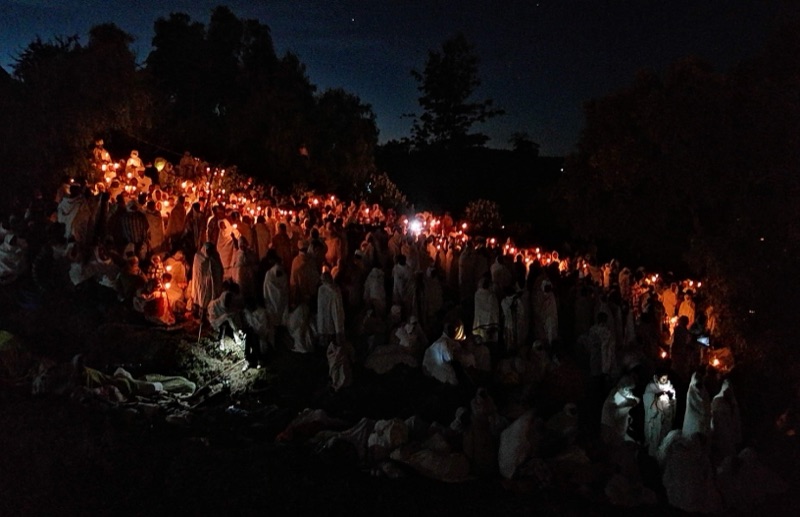
Lalibela, the medieval city of eleven monolithic rock-hewn churches in northern Ethiopia, hosts the largest Genna gathering. Tens of thousands of pilgrims arrive in the days before Christmas, dressed in white netela (handwoven cotton shawls), and stand through the night in candle-lit vigil. Lalibela was carved out of solid volcanic rock in the 12th century by King Lalibela, and the entire town is a UNESCO World Heritage Site. There is nothing else like it anywhere in the world.
Doro wat at the family table
The fast breaks at home with doro wat, a slow-cooked spiced chicken stew with hard-boiled eggs, served with injera. Many families also serve tibs (sauteed beef or lamb), kitfo (minced raw beef seasoned with mitmita and niter kibbeh), and tej, a honey wine reserved for special occasions.
The Genna game
The day shares its name with a centuries-old field game played by men and boys across the highlands. Players use curved sticks to strike a wooden ball, similar in form to field hockey. Tradition holds the game commemorates the shepherds who heard the angels announce the birth of Christ and ran to find the newborn child. Boys still organize Genna matches in village fields on Christmas afternoon.